

The year 2024 marked a pivotal moment for the healthcare sector, driven by major scientific breakthroughs, structural reforms, and the rapid acceleration of digital transformation. In a global context still shaped by the lessons of the pandemic, healthcare systems faced multiple challenges: an aging population, budgetary constraints, and rising demand for personalized care. Yet, this year also brought reasons for optimism, with significant progress in biotechnology, AI-powered medical innovation, and new initiatives to enhance care accessibility.
In France, headline measures reshaped sector priorities, from combating medical deserts to expanding connected health solutions for improved patient monitoring. Globally, promising advances—particularly in rare disease treatments and cancer prevention—demonstrated the innovative capacity of a sector in constant evolution.
Market Context & M&A Drivers in Healthcare in 2024
Healthcare and life sciences M&A activity remained stable in 2024, with a slight increase in deal volume but a 41% drop in average transaction value. After reaching $222 billion in 2023, total deal value declined to an estimated $130 billion in 2024. Despite this decrease, the sector remained dynamic in terms of deal flow. The fast-evolving health landscape—marked by aging populations and growing demand for tailored treatments—has made external growth a strategic imperative. Leading companies have actively sought to integrate new technologies and strengthen their value chains to meet these complex challenges.
Digital health and biotech led this momentum. Artificial Intelligence in particular catalyzed many acquisitions, notably in predictive analytics, connected medical devices, and big data processing. These technologies are now critical differentiators, enabling better diagnostics and care optimization. Large pharmaceutical groups and tech players ramped up strategic acquisitions or partnerships to consolidate their market positions. Simultaneously, investments accelerated in biotherapies and rare disease treatments, segments where rapid innovation is key.
However, the environment presented challenges as well. Regulatory bodies in Europe and the U.S. closely monitored consolidation activity to guard against anti-competitive practices—particularly in sectors where access to care remains a public priority. Technological barriers and uneven international regulations also complicated some cross-border transactions. Nevertheless, the need for innovation, resource pooling, and demographic adaptation continues to drive strong M&A fundamentals in healthcare.
Key Trends in the Healthcare & Life Sciences Sector
In 2024, the healthcare sector underwent major transformation driven by AI, telemedicine, and a greater focus on preventive care. AI revolutionized diagnostics and treatment through advanced tools capable of analyzing complex data and detecting diseases at early stages. These developments led to more personalized and effective treatments, particularly in critical areas like rare diseases and oncology. AI also enhanced remote patient monitoring, offering smart, connected solutions that relieve pressure on traditional healthcare infrastructure.
At the same time, telemedicine emerged as a vital tool for expanding access to care, especially in rural or underserved areas. Remote consultations via digital platforms enabled broader access to specialist care. In parallel, preventive healthcare became a central focus for both public and private actors. Screening programs, awareness initiatives, and digital mental health tools have supported a more proactive approach to public health. These trends reflect the sector’s transition toward a more connected, inclusive, and forward-looking model of care.
Sector Growth & Key Transactions in 2024
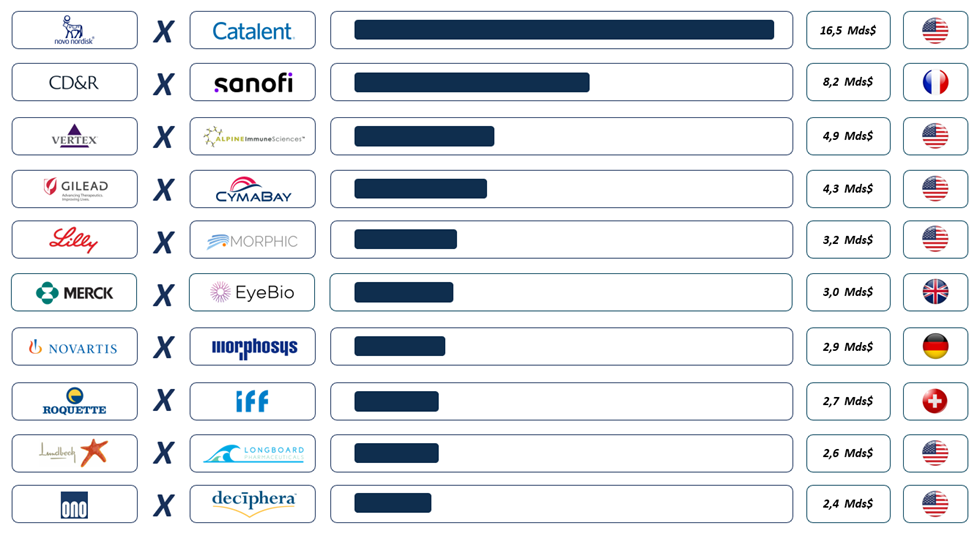
Among the most notable transactions of 2024, Novo Nordisk signed a $16.5 billion agreement in December 2024 to acquire production sites from Catalent for its in-demand weight-loss drug Wegovy. The deal includes three manufacturing facilities located in Italy, Belgium, and the U.S., focused on producing Wegovy injector pens. While both the FTC and European authorities reviewed the transaction, it received approval without objections.
In October 2024, Sanofi entered exclusive negotiations with U.S. private equity firm Clayton, Dubilier & Rice (CD&R) to sell a 50% stake in its consumer healthcare division, Opella, valued at approximately €16 billion. The deal aims to create an independent leader in over-the-counter medications, allowing Sanofi to refocus on innovative medicines and vaccines. Sanofi would retain a significant stake, and Bpifrance is expected to acquire around 2% of Opella, ensuring the retention of decision-making centers and jobs in France. The transaction is expected to close in Q2 2025, pending regulatory approvals and workforce consultations.
In April 2024, Vertex Pharmaceuticals announced the acquisition of Alpine Immune Sciences for $4.9 billion in cash, or $65 per share, representing a 38% premium over Alpine’s share price on April 10. The transaction, unanimously approved by both companies’ boards, strengthens Vertex’s position in treating autoimmune and inflammatory diseases. Alpine’s lead drug candidate, povetacicept, shows promise in treating IgA nephropathy and is expected to enter Phase 3 clinical trials in the second half of 2024.
Top 10 Healthcare & Life Sciences Transactions in 2024
Source: Fierce Pharma
FTC and IRA: Regulatory Pressures Weigh on M&A Activity
In 2024, M&A activity in healthcare faced significant regulatory headwinds, notably from the U.S. Federal Trade Commission (FTC) and compliance requirements under the Inflation Reduction Act (IRA).
These regulations increased scrutiny of deals—especially in biotech and pharmaceuticals—due to concerns over anti-competitive behavior and equitable access to medications. However, with the Trump administration set to take office in January 2025, a potential policy shift could ease these regulatory pressures. The new administration is expected to take a more business-friendly stance, potentially limiting FTC powers and revisiting restrictive IRA provisions.
Such developments could unlock substantial M&A potential in 2025, creating a more favorable environment for companies seeking to reposition themselves in an evolving market.
2025 Market Outlook: Emerging Challenges and Opportunities
Looking ahead to 2025, the healthcare sector stands at a crossroads, facing unprecedented structural, technological, and demographic challenges. The aging population and rising incidence of chronic diseases are placing increasing pressure on healthcare systems. Companies and governments alike must evolve their models to meet complex care demands while maintaining accessibility and inclusivity.
Technological innovation will play a central role in addressing these challenges. AI, already widely adopted in diagnostics and treatment, will continue to reshape medical practice through predictive tools, big data analysis, and telemedicine solutions. Yet, broader adoption raises ethical and regulatory concerns—particularly around data privacy and equitable access to care. Healthcare players will also face mounting pressure on ESG criteria, now critical for attracting investors and meeting regulatory expectations.
From a financial perspective, M&A will remain a key strategic lever. Companies will continue to seek technological capabilities, consolidate market positions, and enter new segments. However, deal-making will be increasingly scrutinized by regulators concerned with market concentration and consumer protection. Geopolitical risks, trade tensions, and global disparities in access to healthcare will further complicate the deal landscape. The wave of M&A in 2023 also reduced the pool of de-risked revenue opportunities available for acquisition, which largely explains the overall decline in healthcare transaction value in 2024.
As a result, 2025 is shaping up to be a pivotal year, where innovation, regulation, and strategic agility will define the sector’s future leaders.
Expert Insight: Philippe Buhl on Healthcare M&A Trends
With more than 25 years of experience leading healthcare groups, Philippe Buhl brings a deep network and unmatched expertise in healthcare M&A.
He has held senior leadership roles at major groups such as Cerba Healthcare and Ramsay Générale de Santé, where he managed multiple LBOs and led M&A operations involving healthcare institutions and private medical practices.
Philippe also held roles at a GE Healthcare subsidiary and led the Centrale d’Achat de l’Hospitalisation Privée et Publique (CAHPP)—one of France’s largest procurement organizations for medical devices and pharmaceuticals—enhancing his mastery of the sector’s strategic and operational challenges.
This unique background makes Philippe Buhl a trusted advisor for healthcare companies navigating digital transformation and market consolidation through strategic M&A.