

Since January 2026, SaaS publishers have undergone a severe stock market correction. Investors fear that AI agents will replace subscriptions billed per user. Private transactions nevertheless tell a different story: a market that continues to reward accumulated sector experience.
Widespread stock market distrust
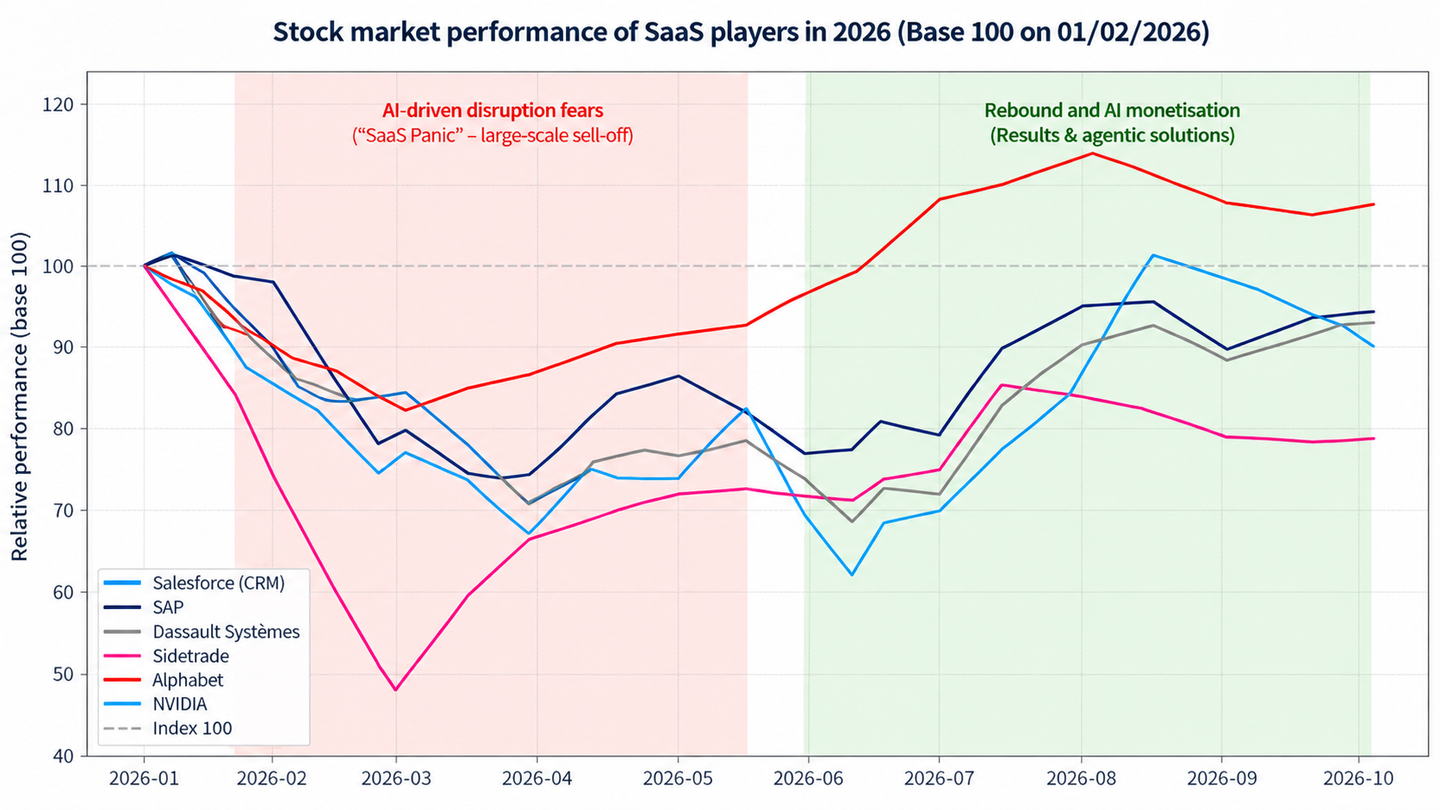
2026 has been marked by a two-stage dynamic in the SaaS market. After a first half dominated by fears that generative AI would disrupt traditional software (SaaS Panic), the third quarter saw a shift in investor perception. AI now appears as a lever for value creation for established publishers, able to capitalise on their sector expertise and proprietary data to enrich their offerings and develop new revenue streams.
This shift is accompanied by a gradual recovery in valuations. While the median revenue multiple of listed publishers tracked by Software Equity Group fell from 5.7x in the second quarter of 2025 to 3.2x a year later, Aventis Advisors has observed a rebound in the median multiple of publishers listed in New York, from 3.2x in June to 4.6x at the end of August.
“After the decline at the start of the year, fuelled by fears linked to AI, the software market is rising again. On the ground, vertical software publishers have proved particularly resilient. Those that have managed to integrate AI into their business have turned it into a growth driver rather than a threat. They have gained market share, and their valuations have followed.”
Pascal BORDAT, Technology, Media & Telecoms expert at AURIS Finance
Sector experience, an asset that is difficult to replicate
A general-purpose model can draft a contract or summarise a table. Yet it has neither the data history built up with clients, nor the business rules incorporated as regulations have evolved, nor the software’s embedding in day-to-day processes.
Goldman Sachs Research believes that vertical software will remain its clients’ systems of record. According to the bank, AI adoption will favour players that control proprietary data. Houlihan Lokey sees the depth of sector data as a barrier to entry for new entrants without a track record. McKinsey counts proprietary data and workflow integration among the lasting advantages as models become widespread. Bain regards it as the lasting differentiating factor in the face of model commoditisation.
Sidetrade illustrates this. On 22 July, the publisher announced record order intake of €5.6 million in the second quarter, up 80% year on year. Its new AI offerings contributed €1.02 million in recurring subscriptions, and its historical SaaS offering remained solid. TP ICAP Midcap sees this as evidence of no disruption from agentic AI. The share price rose 11.3% during the session.
Acquirers continue to pay for specialisation
Private transactions confirm this gap. In the second quarter of 2026, 698 acquisitions of SaaS publishers were announced, 9.6% more than a year earlier. Their median multiple declined only slightly, from 4.2 to 4.0 times revenue. Vertical software accounted for 54% of these transactions, compared with 46% a year earlier. Software Equity Group observes that acquirers favour proprietary data and integration into client processes. Across all software acquisitions, however, the median EBITDA multiple stands at 11.1 times over the last four quarters, compared with an average of 14.0 since 2022.
Private equity is adapting its approach. In the United States, funds invested only $16.24 billion in software over the first five months of 2026. This pace is equivalent to around a quarter of the record $156 billion reached in 2025. Platform acquisitions accounted for only 41% of this value, their lowest share in at least ten years. Add-on acquisitions represented around 45%. Option Finance considers it possible that funds will take advantage of depressed valuations to consolidate niche publishers.
Several transactions in 2026 reflect this preference for sector depth. In April, Avignon-based Kizeo, a publisher of tools for field-based professions, opened its capital for the first time, to Turenne Emergence. Profitable without ever having raised funds, it generates revenue of €10 million with 4,500 clients. CFNews sees this as proof that some publishers are far from threatened by AI.
In May, Francisco Partners acquired 85% of EfficientIP, an IP address specialist, valued at €200 million for revenue of €50 million. In June, PSG Equity invested in CHR Group. The group’s food safety software is used at around 28,000 sites in nearly 50 countries, and it was simultaneously acquiring Rmoni and Andy. The same month, the Swiss publisher Equadis, based in Lyon, completed its first leveraged buyout.
For publishers’ leaders, a defensible valuation rests on demonstrating these assets: data, built-in compliance and the length of client relationships. AURIS Finance’s sector experts, M&A advisers, are available to help you prepare your sale, capital opening or external growth projects.