After three years of decline, the French brewing market regained a semblance of balance in 2025, a stabilisation that masks a profound reshaping of the sector. Off-trade consumption rose by 1.2%, driven by click-and-collect (+6%) and own-label brands (+5.5%), while on-trade consumption fell by 1.5%, in a sector worth €15 billion in revenue and supporting 130,000 jobs.
A Deceptive Stabilisation
With 2,500 to 2,600 breweries in operation according to Projet Amertume, France remains the European country with the largest number of players, micro-businesses and SMEs accounting for 96% of the sector. Yet the balance between openings and closures remains close to nil, with 209 closures against 213 new breweries in 2025. The Syndicat National des Brasseries Indépendantes (SNBI) reports the disappearance of more than 500 businesses in two years, and is calling for a state-guaranteed loan for breweries producing fewer than 200,000 hectolitres.
At the Base of the Pyramid, Selection Is Intensifying
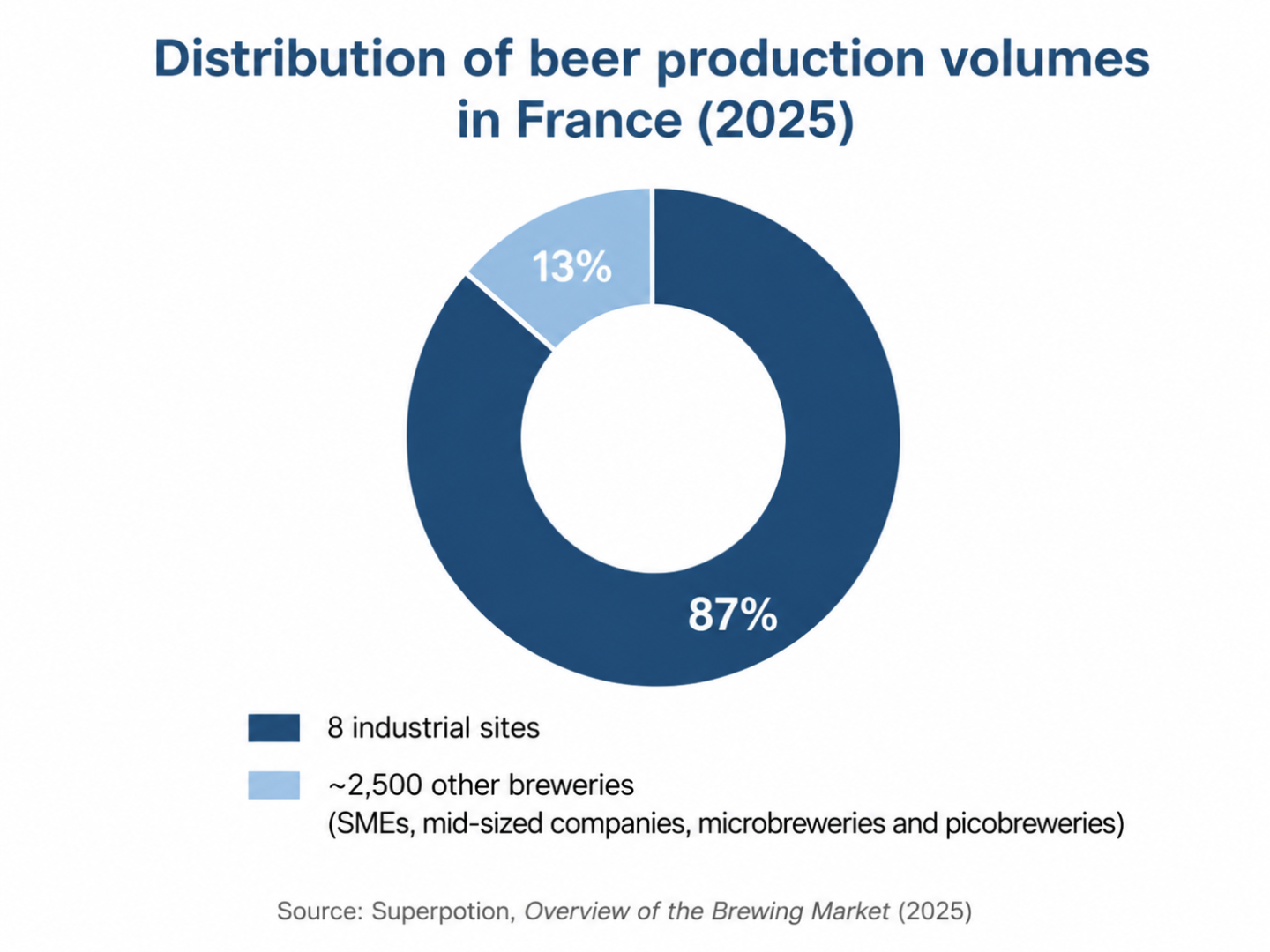
Eight industrial sites account for 87% of volumes produced, against 13% for the some 2,500 other breweries in the country (see chart). For microbreweries and picobreweries, without an established brand or critical volumes, convincing a buyer remains a demanding exercise. Pooling production resources is emerging as a more flexible solution than an outright sale, allowing capacity to be increased without relinquishing independence.
Structured SMEs and Mid-Sized Companies Are Regaining the Initiative
At the other end of the spectrum, structured SMEs and mid-sized companies are organising their growth through capital. The equity opening of Fabulous French Brasseurs is the most fully documented example. The Finistère-based group, with 144 employees and €32 million in revenue, which brings together Brasserie de Bretagne, Brasserie du Dauphiné, Brasserie de Vézelay and Brasserie artisanale du Sud, has sold 65% of its capital to FrenchFood Capital, Bpifrance and BNP Paribas Développement. The transaction is intended to finance a €10 million investment plan over five years, including €5 million from the end of 2026 to double the capacity of the Concarneau site.
Commercial Alliances, Another Route to Consolidation
The acquisition of the Lil, Carnavaleuse and Bradeuse brands from Brasserie Gobrecht, in Lille, by Newbeers, a group built around Mélusine in the Vendée alongside Parisis, Page 24 and la Berlue, illustrates a different logic, that of brand value rather than industrial assets. Gobrecht had ceased production as early as March 2025, and it was indeed the brands that were taken over rather than the site, their brewing being transferred to Page 24, in the Pas-de-Calais. Other players are favouring a different route, commercial pooling rather than acquisition: The Beers Family, founded in 2019 by Brasserie Duyck, producer of Jenlain beer, alongside 3 Monts, has since extended its alliance to LBF, to Maison Sassy cider and, more recently, to spirits producer Société des Alcools à Papa. Each brand retains its capital independence while pooling its sales force in large-scale retail.
The Product, a New Ground for Differentiation
The product is also becoming a lever of differentiation. Alcohol-free beer now represents one in twenty beers consumed in France and remains, according to the SoWine-Dynata barometer, the preferred alcohol-free drink of 61% of French consumers. The can is establishing itself as the reference format in large-scale retail, driven by French players specialising in mobile canning such as Remplis-moi and Canette Factory. Direct sales through brewpubs, more than 200 active establishments with two net openings per month in 2025, are becoming a valuable growth driver for the smallest businesses.
An M&A Market Under Pressure, Favourable to Mid-Sized Companies and SMEs
This movement is part of a broader trend in the French SME M&A market, which contracted in 2025, with 1,076 transactions against 1,226 a year earlier, a decline of 12%, while valuation multiples in industry stand at between 6 and 7 times EBITDA. This context of easing valuations benefits mid-sized companies, which retain robust equity and direct access to financing, unlike SMEs, more exposed to bank credit rationing.
What Trajectory for the Second Half of 2026?
For the second half of 2026, the most likely trajectory is neither a general rebound nor a fresh collapse, but greater selectivity. Intermediate groups and commercial alliances should continue their targeted acquisitions of high-profile brands, while the sale of micro and picobreweries will remain demanding for want of buyers. Nationally, 54.2% of mid-sized companies have launched or are planning an acquisition project this year, a signal suggesting that this external growth dynamic will continue to feed the brewing sector until the end of the year.
Auris Finance supports company directors in the brewing sector in their growth transactions, as illustrated by the recent combination of the cooperative group Cérèsia and the craft brewery La Bouquine, in Reims.
Are you considering a sale, a fundraising or an industrial partnership?